
Why Left and Right Rear Shocks Sometimes Share One Part Number
Why Left and Right Rear Shocks Sometimes Share One Part Number
Some rear suspensions use the same shock absorber on the left and right because the two mounting paths, clearances and damper specifications are symmetrical. Other vehicles require mirrored brackets, different offsets or side-specific connections.…
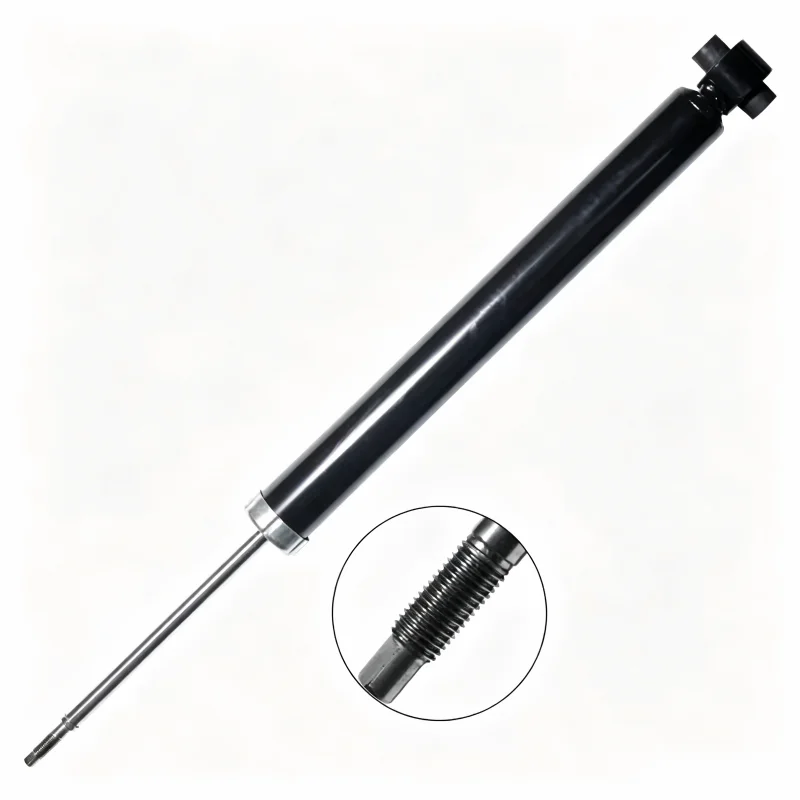
What allows one shock to serve both sides
A simple shock with centered upper and lower mounts may present the same geometry when moved across the vehicle. If the vehicle diagram assigns the same reference to both positions and the component maker lists two units per application, one part number can legitimately cover the axle.
That arrangement simplifies inventory, but it is application-specific. Another generation of the same model may add a welded brake-hose bracket, electronic connection, offset lower eye or protective shield that makes the two sides different.
Features that can make a shock side-specific
- a hose, wire or sensor bracket welded at one orientation;
- an offset eye, fork, bar pin or mounting stud;
- clearance around the exhaust, fuel tank or suspension link;
- an asymmetric dust shield or spring seat;
- electronic, air or hydraulic connections routed to one side;
- a part-number suffix or catalog note assigning left or right.
A photograph can expose a mirrored bracket or obvious offset. Identical silhouettes cannot prove equal damping, internal construction or application. Keep the catalog identity attached to the visual comparison.
Why “quantity required: 2” is not “pair included”
A manufacturer catalog may list quantity per application to show that the vehicle needs two units. An ecommerce page may price and ship one shock. If the listing turns the catalog quantity into “pair,” the buyer can receive half the expected order or purchase twice what is needed.
| Field | Question it answers | Example wording |
|---|---|---|
| Axle position | Where on the vehicle? | Rear |
| Side coverage | Left, right or both? | Same catalog reference used at left and right |
| Quantity per vehicle | How many units complete the application? | Two, where the catalog states it |
| Sale-unit quantity | How many pieces arrive for one ordered unit? | Sold individually |
How to verify a same-number application
- Use the exact vehicle, market, production range and suspension configuration.
- Open the axle diagram and confirm the number at both left and right callouts.
- Check the component maker’s position and quantity fields.
- Read footnotes for side, orientation or suspension-option conditions.
- Compare upper/lower mounts and any welded brackets on the received parts.
A KYB product guide, for example, can list position, mount types and quantity per application in separate fields. That is the structure to preserve. The example does not establish the same side rule for an unrelated shock.
When the catalog says only “rear”
Do not assume that “rear” means both sides. Look for the vehicle diagram, separate left/right columns or quantity per application. If the available source does not resolve side coverage, publish only the supported rear position and leave the side field unconfirmed.
Photographs of both removed shocks can help. Capture full labels, upper and lower mounts and any brackets in comparable orientations. Matching installed numbers support a shared application, but prior repair history remains a limitation until the vehicle catalog agrees.
Handling a left/right conflict at the counter
If the buyer asks for a right shock and the proposed catalog returns one common number, explain the common application and confirm that the sale unit is one piece. If the removed right-side part carries a different suffix, stop the order and compare production, suspension option and prior replacement history.
Do not remove the side wording from the complaint after finding a common number. The reported side remains useful for diagnosing installation damage, noise or a mismatched previous repair even when the new service part serves both positions.
Stock and listing consequences
A common part can reduce the number of inventory lines, while demand should still reflect two units per documented vehicle application. Store required quantity separately so forecasting and online pricing do not confuse one piece with one axle set.
For wholesale cartons, state pieces per inner box and master carton independently from quantity per vehicle. “20 pieces” describes packaging; “two per vehicle” describes use.
Questions about left and right shocks
Can a common rear shock be rotated during installation?
Only as the exact instructions permit. A common left/right number can still have an up/down or bracket orientation requirement.
Should both rear shocks be replaced when only one is damaged?
Follow the vehicle and component maker’s service guidance and assess the other side. Replacement strategy is separate from the number and package-quantity question.
Does a lack of welded brackets prove both sides are the same?
No. Mount offsets, internal specification or catalog assignments can still differ.
Can one carton labeled “rear shock” contain a pair?
It can, but the exact package list must say so. Never infer a pair from the plural application requirement.
A shared rear-shock number is useful when the catalog proves it. Keeping side coverage, application quantity and sale-unit quantity independent lets that simplicity reach the buyer without creating a wrong-side or wrong-quantity order.
Related articles


